


I still remember the spring day, decades ago, when I discovered that the afternoon could be a good time to kill a turkey. It was the very first year when Wisconsin allowed turkey hunting until 5:00 p.m. instead of the usual noon closing time. Those afternoon gobblers beckoned.
This was still early in my turkey hunting career. Having learned a few things at the hands of several accomplished woodsmen of the hard-hunted East – in New York State, Tennessee, Massachusetts and West Virginia, where turkey hunting hours ended (and still do) at noon – I sort of felt like I was cheating, or maybe just killing time, when I headed out after lunchtime.
After all, turkeys are best called and killed in the morning, and preferably the earlier the better, right?
But a turkey hunter I am, and no matter the outcome, what better way to spend a warm May afternoon than outside with the sun shining and puffy white clouds sprinkling a blue sky?
What I didn’t factor into my mixed feelings, though, was this reality: Turkeys are out there being turkeys no matter what the clock may say.
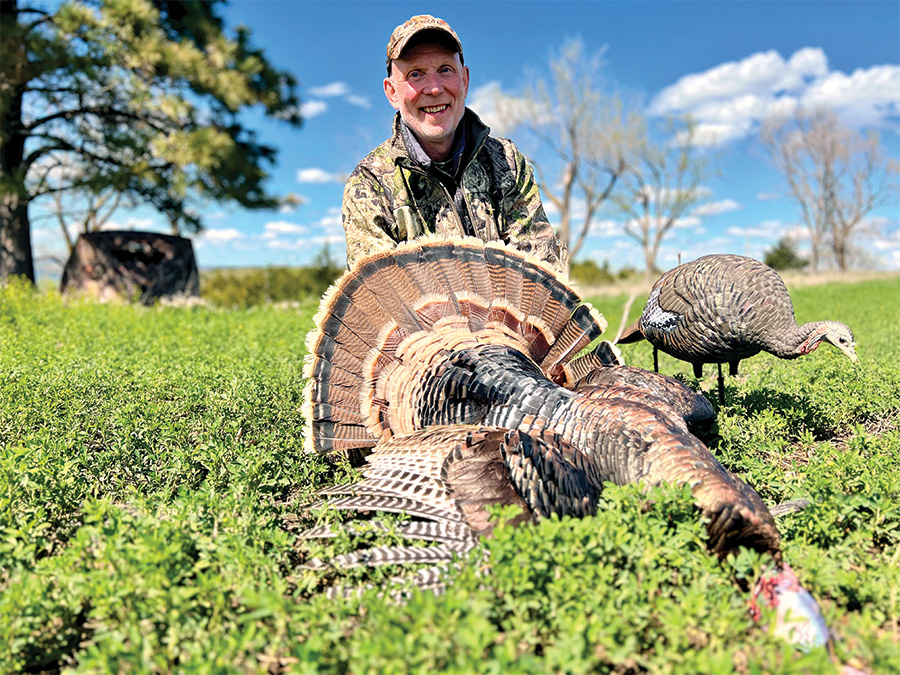
Photo courtesy of Tom Carpenter.
Driving back out to hunt after lunchtime, I spotted several dark figures down in a hayfield corner where, by the way, I had spent a mid-morning hour set up. Two hens now fed in the foot-tall alfalfa, with a red-headed gobbler dutifully following along and occasionally puffing into strut.
I watched the turkeys feed on, and finally the birds headed back into the oak timber. Game on! I scurried down and called, but you know the results of that.
The next afternoon I was stationed in that same field corner, set up and waiting. The birds showed up in the field a little over an hour later, right on schedule. Two hens and a gobbler. They took their merry time. I called softly on occasion, but they paid little heed, so I played it soft and coy, and then silent.
I can’t say that I called the gobbler in. I can say I didn’t scare the birds away. I did shoot that gobbler after the hens finally fed on past, with him pulling up the rear.
***
When I started hunting west from my native Wisconsin and Minnesota home grounds, to South Dakota and Nebraska and Montana, afternoon hunting was part of the fabric of the turkey chase in those places. Those afternoon gobblers beckoned.
Heck, I even discovered that some hunters prefer hunting in the afternoon. They knew what they were doing. That’s really where I cut my afternoon turkey hunting teeth.
What did I learn on my way to giving afternoon turkey hunting the respect it deserves?
The later couple hours of the afternoon – from 2:00 to 5:00 p.m. or so – are most productive. They are better for hunting than the evening hours, when birds get cagier than ever and are more interested in ending the day alive than breeding or feeding.
Turkeys get hungry. Spring days are mighty long. Birds are ready to go out on the feed again by mid to late afternoon, and do.
Nesting hens are especially likely to leave their eggs and eat now – their one feeding session for the day. Gobblers are still interested, and not far behind.
The gals don’t show much interest in breeding in the afternoon; that gives you a little better chance to call away a curious gobbler who has been jilted and ignored most of the day.
Gobblers that have lost contact with the hens will head out now to patrol areas where they know hens feed. What more can a hunter ask for than a lonely gobbler?
Shadows get long, and that is an offbeat help to the hunter. By late afternoon, many woods edges can produce the shade necessary for feeding turkeys to feel safe. Many afternoon turkeys stick close to cover, where the shade is, so they can duck back into the timber or brush if something appears amiss.
Gobblers eat during the breeding season, and afternoon is when they do it. The birds are too busy in the morning, trying to get some hen action. By late afternoon, however, life is a lot calmer, and gobblers will settle in to fill their crops in a greening hayfield, stubble field, plowed ground, open pasture or woodland glade.
***
There are two good ways to hunt afternoon gobblers. Here’s the first way: Wait ‘em out.
Scout. Look. Glass. Study. Know where turkeys are travelling and feeding. If you have some birds patterned (like the Wisconsin trio that started our story), set up at that likely spot and wait them out.
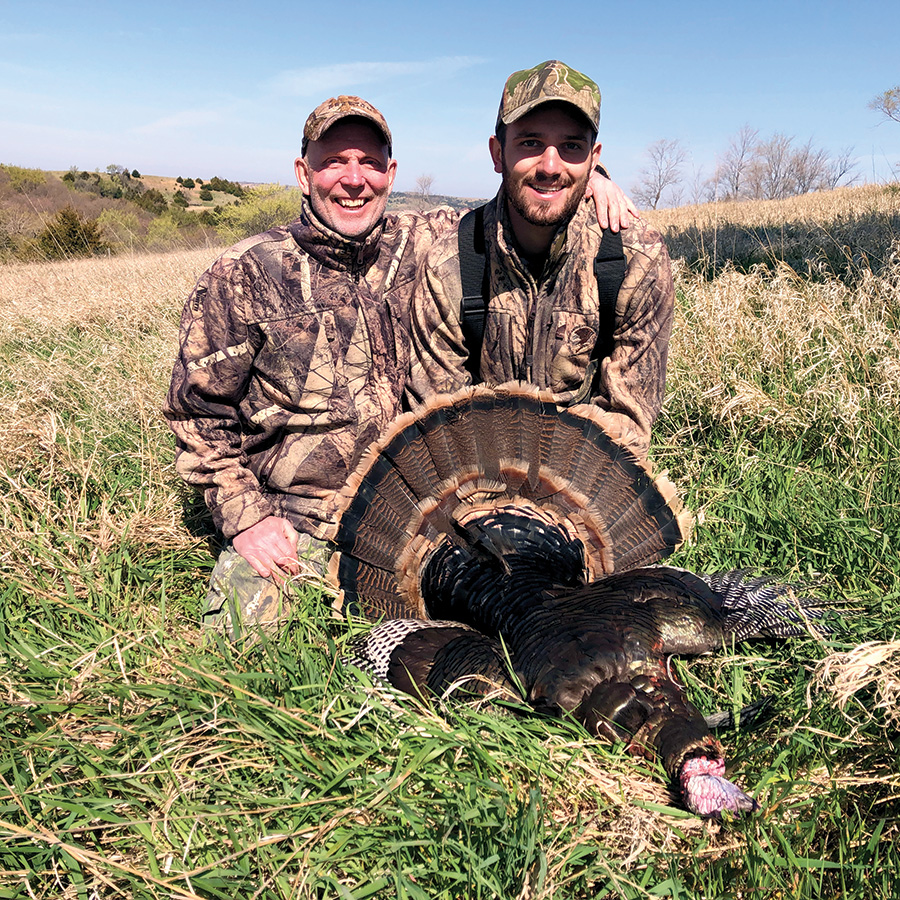
Photo courtesy of Tom Carpenter.
If they were there yesterday, or the day before, why not today? If you find turkey evidence – tracks, droppings, feathers – that’s almost as good as seeing them.
When it comes to setting up on turkeys, decoys can be hit-and-miss in the afternoon.
The hits can come when a gobbler (or two or three) is travelling without hens. If I use a decoy, I use one hen in the afternoon. Gobblers aren’t quite as aggressive now — especially those young and satellite gobblers that are likely to be on the prowl by themselves — and they don’t have any interest in engaging a boss gobbler decoy. But a lonely hen decoy? They might chance it.
The misses can come when the hens are out and about. I have seen more hens avoid a hen decoy than I have seen come to one in the afternoon, and when they leave, off go any attached gobblers too.
I am more likely to use a decoy in a field situation than in the woods. And by the way, a good woodland feeding area, such as an oak ridgetop or flat, makes a great afternoon setup.
Let’s end the decoy talk with this thought. If you’ve put in the scouting work and really, really know turkeys travel it, why alter the environment with a fake that might make them suspicious?
***
Given a choice, I’ll take an afternoon sit over moving out and trying to call up some action.
To be honest, I’ll even take a nap or two while waiting. Why not? I was up early. It can be a long session, and a few zzz’s kill some time … and rejuvenate a guy. Napping has yet to cost me a turkey; but it has made for some fine surprises — stories for another time.
Calling afternoon turkeys can work, but keep your approach subtle whether you are sitting and waiting, or trolling and maneuvering. Birds are mostly quiet at this time of day, and anything but the softest clucks, sweetest purrs and whispery little yelps will arouse suspicion.
The exception, and there always are exceptions, is if you hear or get a tom gobbling. Then you have to take his temperature and give him what he wants. That could be a lot of yakkety-yak.
***
If you like to move and hunt, give it a try. It can work. Some would call it a “run and gun” but I prefer to call it “trolling.” Gobblers will gobble in the afternoon, and perhaps you can get one to sound off, then maneuver and set up on him.
To the west, where I do a lot of my hunting these days, I really like heading out and glassing for birds, then putting on a sneak to get into position to call one.
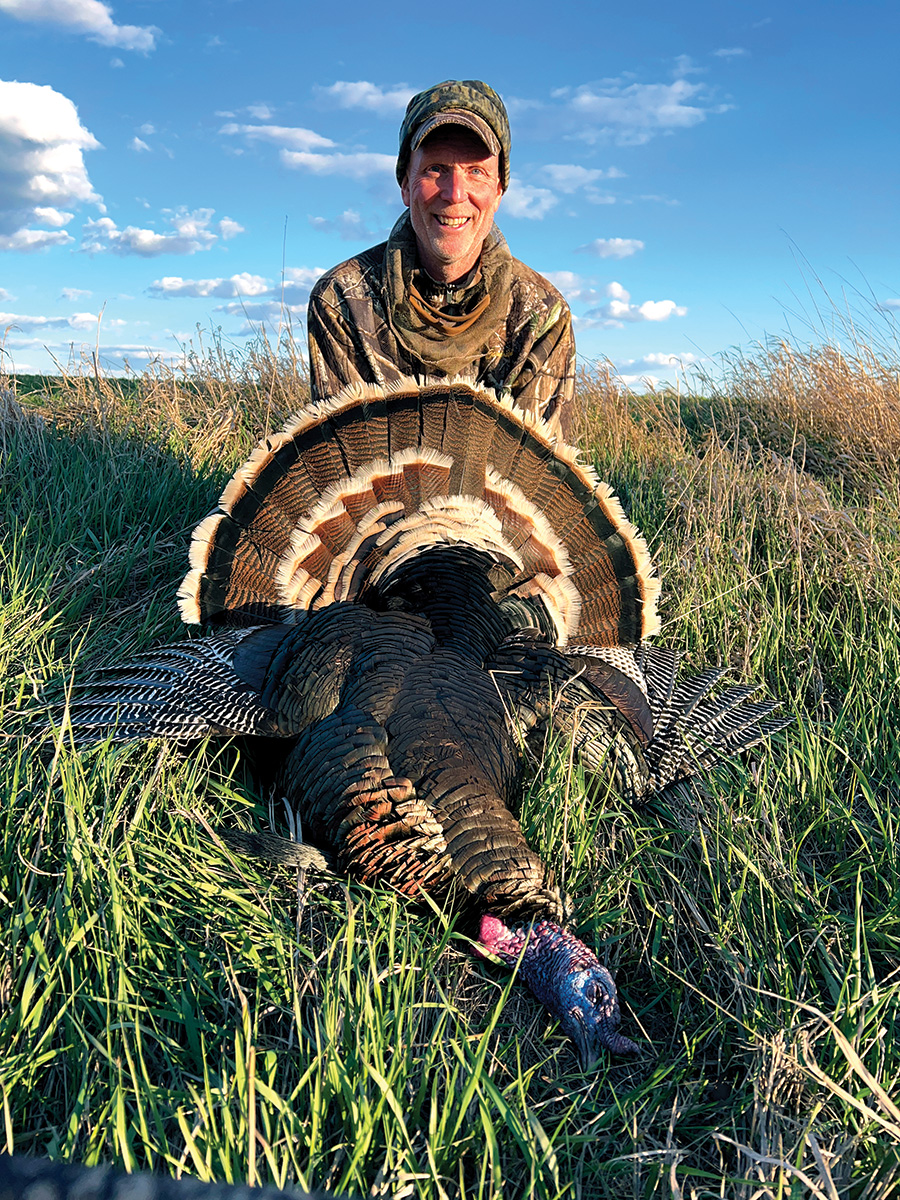
Photo courtesy of Tom Carpenter.
Just remember this cardinal rule of turkey hunting: It is easier to call turkeys to where they are going than it is to call them back.
As matter of fact, I can count on one hand the number of times I have ever been able to do the latter. Be ready to move and maneuver, and don’t get lazy about it.
Here’s a case in point. One windy and sunny Nebraska afternoon, I watched a small flock of birds, three hens and a couple gobblers, mooching along a drainage.
I was pinned: too much open country and too little cover to make a move. On my belly, I studied the birds and their route, trying to figure out which way they were heading for sure; but they were being turkeys and taking their time. I needed some terrain to use to stay out of sight and get ahead.
Over the course of an hour, the birds angled and fed their way toward the top of the opposite ridge and then finally, finally, headed over to the other side. I made my move.
I high-tailed it in the drainage they had vacated, glancing occasionally up to the ridge to make sure a “snitch” hen hadn’t peeked back, but luck was with me.
I passed the cedar tree where I had marked their topping-over, and continued another quarter mile and then, for good measure, another couple hundred yards, before crawling over the ridge and into the other drainage.
There was a nice little grove of bur oaks, and I hop-alonged into it, crept to the widest and burliest trunk, and settled in.
After a few little yelps, I shut up. Five minutes later, a gray head appeared over a rise, then another and another. The hens scratched along, and soon came the redheads.
I got to eat a much-needed supper in town that evening, and was mighty glad to have stuck around for some afternoon turkey hunting.
***
Since that fateful and magical Wisconsin day so long ago, those afternoon gobblers have been very good to me. They can be good to you too.
While every afternoon bird brought to bag was a challenge either through diligent scouting and reconnaissance, long waiting, careful maneuvering, smart calling, or a combination of all those factors, afternoon turkey hunting is worth the effort.
And, I might add, quite pleasant. Especially if you can sneak a little nap in.
Tom Carpenter has been writing for DDH & TTH for more than a quarter century, and hunting turkeys between lunch and suppertime for a lot longer than that.

Order the 2026 Turkey & Turkey Hunting Magazine for even more turkey hunting tips, tactics and strategies.