


We had already struck out finding a turkey to call off of the roost and started to check potential spots by stopping and calling to strike a bird. Great-looking spots produced no gobbles, and when we hit some off-the-beaten-path fields, we produced loud clucks that generated a responsive thundering gobble, and another and another. The birds were half a mile away, and we scurried down a wooded creek to cut the distance. When we reached the last stretch of good cover, we set up a hen decoy, sat back in the woods, and started hen calling.
The woods came alive with raspy gobbles that reverberated across the field. There were multiple longbeards that competed for air space, and they sounded off one after another. We eventually saw heads appear on the far edge of the field. The birds worked their way onto a rise and, one by one, stood silhouetted against the sky. A huge, dark bird was in full display as hens meandered around him. A second mature bird came into view, and the white edges of his feathers left no doubt it was a full-blood Merriam’s. The flock slowly went out into the pasture, where we hoped to draw them across.
The hens led the way with the longbeards strutting circles through the group. The darkest gobbler was the dominant bird in the flock, and the white-fringed bird was slightly timid. Our calling and decoy garnered little attention, and when we knew there was little chance to draw the birds another 300 yards, it was time to get creative.
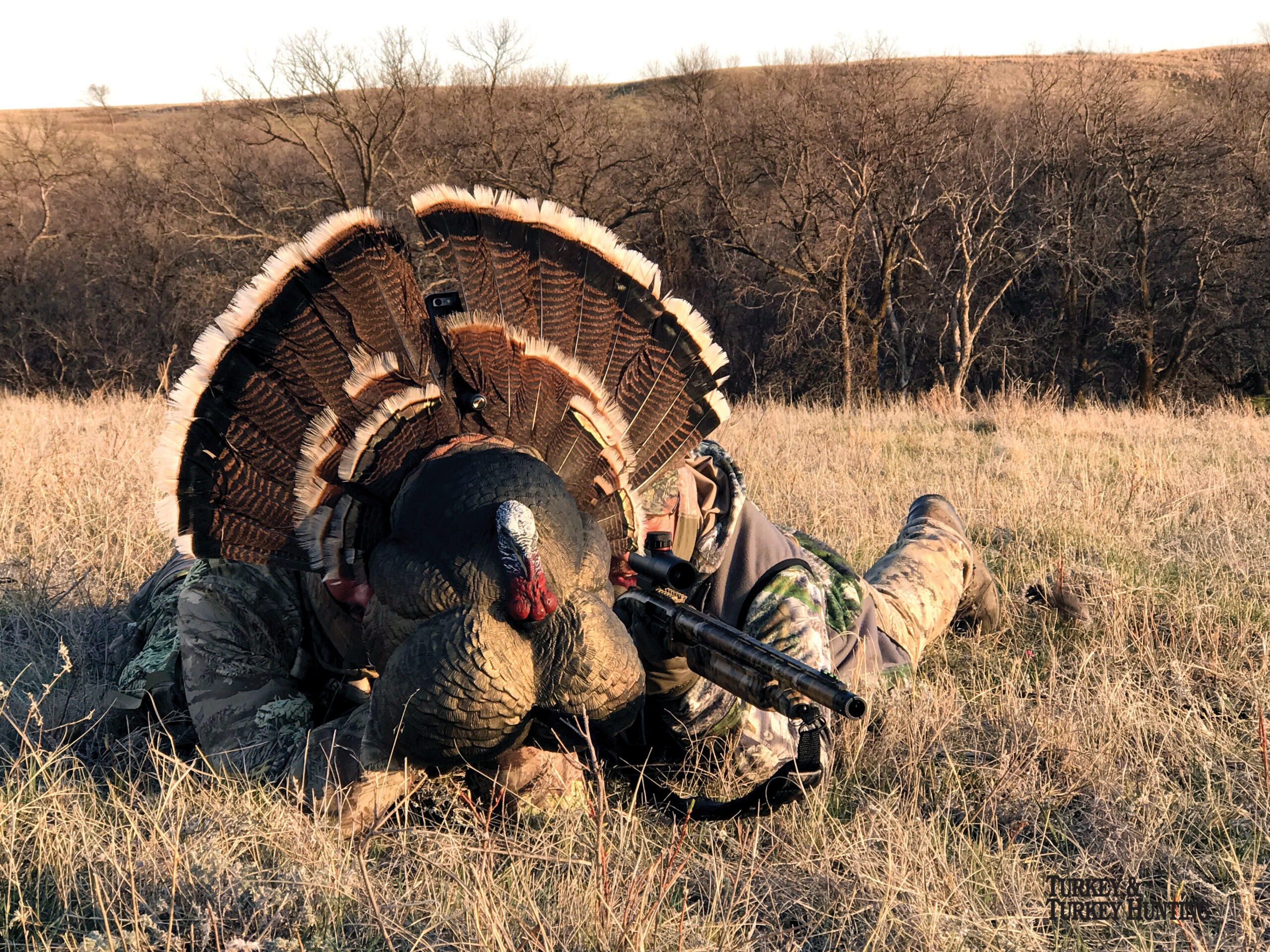
The fan operator can stay well concealed behind a fan. Photo by Brad Fenson.
Most turkey hunters live for the challenge to decoy and call a spring gobbler into range, but any seasoned longbeard chaser can tell you that the usual tactics don’t always work. It can get frustrating when toms are henned up and refuse to respond. When all else fails, forget the hen decoy and strategy based on love, and try acting like a strutting competitor moving into a dominant bird’s territory. You will quickly determine that the boss bird reacts quicker as a fighter than a lover.
The one thing you can always count on with wild turkeys is their incredible eyesight. When my hunting buddy, Ken Buyers, smiled and pulled out a turkey tail fan, I put on my leather gloves in preparation for crawling. There was a corral in the field and just enough of a dip in the terrain to allow us to cut the distance to the birds. We slithered across the grass, avoiding cow pies to put us about 100 yards from the closest hens. There was lots of clucking and drumming coming from the live birds, and I kept my eye on the big Merriam’s, even though the other bird was dominant. My prize was the brilliant white on the feathers that stood out like a neon sign.
Ken whispered that he would hold up the fan, and we would crawl behind it into the open. We had not been able to draw any attention from the birds, so when we held up the turkey tail fan, the two strutters immediately locked onto it. The gobblers watched with a jaundiced eye, but the hens made the first move toward us. If you know anything about toms, you’ll understand how territorial and aggressive they can be with each other. The pecking order must be followed, or a fight will ensue to decide who the boss is.
There were about 15 turkeys, and the two gobblers danced to keep their feathers up and keep up with the ladies. Ken moved the fan back and forth like a new competitor trying to garner attention, and it worked. Sometimes, the two toms would have to come out of strut to run and catch up with the hens. Tail fans were dropped to one side a few times as they tried to strut and trot simultaneously.
Our strategy had worked, and the closest hens were 20 yards away, with the gobblers 20 yards behind them. I could feel the tension rise. The hens could figure out what was really going on. The big Merriam’s was off to one side, providing a clear view without other birds behind it. The closest hen was 12 yards away, and Ken hissed that I better find a way to shoot. Rising on my elbows, I shouldered the Weatherby 18i semiautomatic shotgun, centered the red dot in the Burris FastFire 4 optic on the base of the bird’s neck, and squeezed the trigger. Chaos ensued, with turkeys running at breakneck speed as the prize of the trip flopped on the ground.
Strategy
The traditional method for bringing gobblers to the hunter is to set out hen decoys and make hen calls. However, many believe this is the opposite of how male turkeys behave — and toms expect the hens to travel to them, attracted by their loud, reverberating gobbles and display of feathers. After leaving the roost, experienced turkey hunters have seen hens heading toward a gobbler.
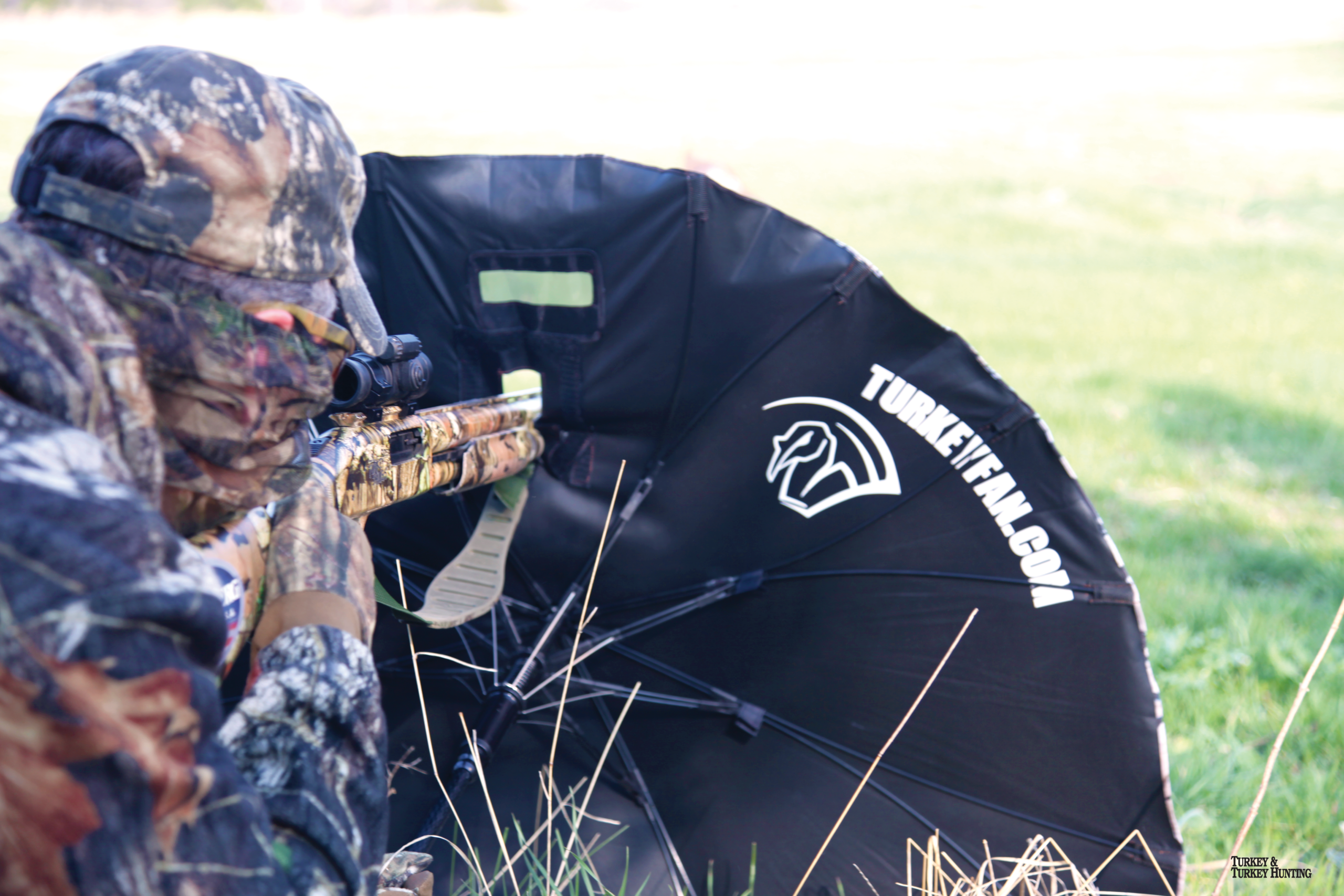
There are many types of products available that can successfully fan a turkey. Photo by Brad Fenson.
When a mature gobbler comes to a hen call, it’s often because he doesn’t already have a lady or he’s looking to steal some action. Have you ever experienced a hen showing up to ruin your hunt by coming in and stealing a working gobbler away from your setup? With fanning, you avoid the entire male and female mating dynamic and turn the tides by working on the tom’s territorial nature.
You can utilize the fanning tactic any time you see a male turkey displaying, and it will perceive the activity as a challenge to its dominance. Fanning also works on turkeys out for a wander or when feeding. On another hunt, we spotted a big gobbler making tracks along a fence clear across an alfalfa field. We figured nothing ventured, nothing gained, so we crawled a short distance into the field and threw up a turkey fan. A couple of hen calls stopped the old boy in his tracks, and he stared at the fan for about 10 seconds before deciding to make tracks in our direction. The big, old bird ran most of the way across the field and slowed at 100 yards to start displaying and sizing up the competition. The incoming bird was the challenger, confident in his ability, continually closing the distance. It had only been minutes since we first spotted the bird, now at 30 yards. The gobbler started to look nervous with a closer look at the situation, and I shot it before it had a chance to plan a retreat.
Experience with a fan has also proven that jakes are highly susceptible to fanning, especially when in groups. A group of jakes is like a pack of thugs and will often gang up on mature gobblers. When the young males see your fan, they’ll come running in anticipation of tormenting a mature bird as an organized gang.
Communication
A male turkey will fan its tail feathers much like a bull moose displays his antlers, turning them from side to side to ensure everyone can see them. A turkey in full strut will turn in all directions and look as dominant as possible. Gobblers in a given area have a distinct pecking order already worked out. When a stranger or new competitor appears on the scene, it always stimulates an investigation that ultimately ends in a fight. Being bold enough to display a turkey fan in an area where the birds already know where they stand with each other is like waving a red flag at a bull.
Teamwork
When fanning, it is beneficial to work target birds as a team. One person operates the fan, using it as cover to watch for the reaction and advancement of incoming birds. The second person, or shooter, remains low and out of sight to one side. The shooter stays low and waits for reports from the fanner, who also does the spotting and play-by-play. Safety is paramount, and if crawling behind the person with the fan, always keep your shotgun or bow pointed to the side.
Another strategy is to have the person operating the fan draw birds into the shooter’s lane. A good and safe way to get a clean shot is to position the shooter 10 to 20 yards away in available cover from the person with the fan. That way, the tom will be fixated on the fan and strut unwittingly past the shooter. You can fan while hunting solo, but it does take a little more finesse and a stake to hold the fan up when it is time to shoot.
Stack the Odds
Whether fanning alone or with a teammate, get as close to your target bird as possible without being seen. The closer, the better, but we have drawn gobblers from as far as 500 yards away. If you see turkeys in the distance, throw up a fan and crawl out of cover so they can see it. Hold it high, wave it back and forth, and if you can get the sun on it, even better.
Safety Always
Some hunters feel it is unsafe to use a fan to attract turkeys. Just as with any hunting tactic, safety should always come first. Always check your surroundings before setting up. If you are facing a bird, it is highly unlikely that another hunter will approach from that direction. A fan is seen best from the front, and hunters behind it are obvious from any other direction. With that being said, only use a fan when hunting on private land when no other hunting parties have access. Only use fanning in open terrain, where other hunters can see you clearly.
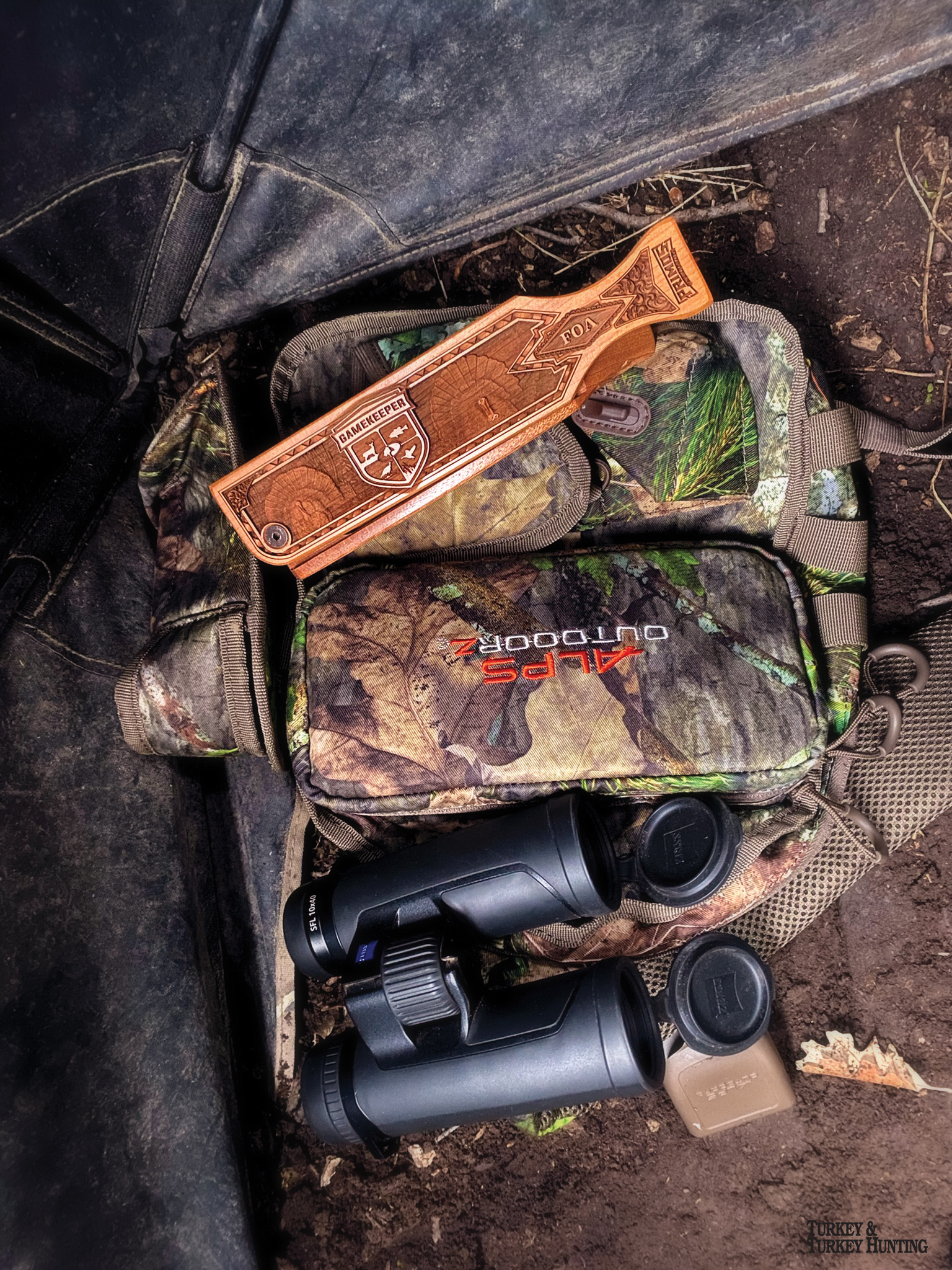
ALPS Outdoorz Ambush Sling Pack
Turkey hunters that like to stay mobile will appreciate the Ambush Sling Pack. This one-strap pack is lightweight and designed for run-and-gun hunters, or getting down to sneak toward birds and still keep gear organized, secure and safe. The single shoulder strap holds the pack snugly in place and is ambidextrous. The strap allows the user to mount a crossbow or shotgun without having a shoulder strap impede the stock. It has MOLLE attachments on both sides, which allow a Thermacell pocket to attach to either side of the sling, in addition to other accessories. The Ambush weighs 1 pound empty, and there are multiple pockets to pack everything you will need to be successful this turkey season.
INFO: ALPSOUTDOORZ.COM
The Real McCoy or Decoy
Nothing beats real feathers when it comes to fanning a mature gobbler. If you successfully harvest a mature strutter, cut off the tail section — including the shiny, colorful rump feathers. Keep the bottom end of the spine attached and scrape out any fleshy parts with a knife, then treat any skin, remaining fat, or flesh with Borax to dry and preserve it. The best way to do this is to open up the fan and pin the feathers down onto a piece of cardboard so they remain spread out. When the skin dries, it will last for years and can even be used in the rain or when heavy dew occurs.
There are commercially made fans available to add real feathers to, and some have artificial fans. There are even umbrella-like decoys that can be used for fanning.
After you figure out the type of fan to use, and with safety always at the top of your mind, add this fun tactic to your turkey hunting bag of tricks. Just be ready for some heart-pounding action.
Order the 2026 issue of Turkey & Turkey Hunting here.